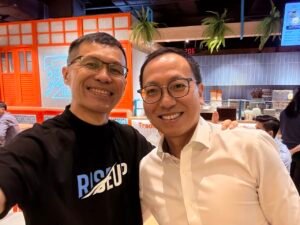
Career growth is not always linear. Some of the most meaningful leadership opportunities arrive through a route we did not plan, a mentor we did not expect, or a role that initially sits outside the career story we imagined for ourselves.
That was one of the strongest reflections from Joseph Wong’s RISEUP Conversation with Siu Ming Hong, Managing Director and CHRO of Fullerton Fund Management. Siu Ming’s first interest was investment and analysis. Yet his journey eventually led him into HR within financial services, where he now leads at the highest level.
The lesson is not that planning is useless. The lesson is that career clarity should give direction without making us rigid. Leaders grow when they know what matters to them, stay open to unfamiliar experiences, and recognise the people and opportunities that can stretch them into a larger version of themselves.
About This RISEUP Conversation
The RISEUP Conversation with Leaders series captures honest reflections from senior leaders about the experiences that shaped how they work, lead, decide, and grow. These conversations are not meant to present a polished career script. They reveal the human side of leadership development: the turns, tensions, relationships, and decisions that rarely fit neatly into a resume.
Joseph had known of Siu Ming’s leadership since his Great Eastern days, but they had not previously had the opportunity to sit down for a candid conversation. The eventual conversation carried a simple but useful question for any leader or HR team: what if the opportunity that grows you most is not the one you originally planned for?
This article expands Joseph’s LinkedIn reflection into a practical guide for leaders, HR teams, and organisations that want to develop people who can respond well to changing career paths and unexpected leadership opportunities.
What Siu Ming Hong’s Journey Shows
Three ideas from the conversation are attributable to the LinkedIn source. The practical implications below expand those ideas for leaders and organisations.
| Conversation insight | What it means in practice |
| Be adventurous and experience as much as you can. | Growth often comes through exposure before certainty. Leaders build judgement by entering unfamiliar contexts, not only by repeating what they already know. |
| Mentors matter more than we realise. | Mentors do more than advise. They notice potential, open doors, create space, and challenge people to stretch beyond their current self-image. |
| Be clear about what you want without becoming rigid about the route. | Career clarity gives direction, but too much attachment to one fixed path can cause leaders to miss opportunities that better fit who they are becoming. |
1. Growth Comes From Exposure Before Certainty
Many professionals wait until they feel fully ready before stepping into a new role, project, or responsibility. That instinct is understandable. It is also one of the reasons career growth stalls. The opportunities that expand us rarely arrive with complete information.
Siu Ming’s journey is a useful reminder. His early interest was investment and analysis, yet his career opened into HR leadership within financial services. That movement matters because it shows how capability can transfer across domains. Analytical discipline, business understanding, stakeholder judgement, and people insight are not separate worlds when a leader learns how to connect them.
For emerging leaders, the point is not to chase every opportunity. It is to ask whether a new experience will widen your judgment, increase your exposure, or deepen your understanding of how organisations actually work. The route may look indirect from the outside, but the capability being built may be exactly what the next stage requires.
The Exposure Map
A practical way to assess an unfamiliar opportunity is to map what it exposes you to. Before saying yes or no, ask what the opportunity gives you access to:
- A new business problem you have not solved before.
- A different stakeholder group or decision environment.
- A capability you cannot build in your current role.
- A mentor, sponsor, or network you would not otherwise meet.
- A test of courage, adaptability, or judgement under ambiguity.
If the opportunity gives you two or three of these, it may be more valuable than a role that looks cleaner on paper but only repeats what you already know.
2. Mentors Help Us See the Possibility We Cannot Yet See
The right mentors do more than offer advice. Advice is useful, but it is not the deepest gift of mentorship. A good mentor sees possibility before the person has language for it. They can name strengths, challenge self-limiting assumptions, and create enough space for a person to step into a larger responsibility.
This is especially important in career moments that do not look logical yet. When a professional is moving from one field into another, or from specialist work into people leadership, they often need someone who can translate their existing strengths into the next context.
That is why mentorship is not only an individual advantage. It is an organisational capability. Companies that build strong mentoring cultures create more internal mobility, better leadership pipelines, and more confident transitions into roles that require judgement rather than only technical expertise.
What Good Mentors Actually Do
| Mentor behaviour | Why it matters |
| See potential | They notice patterns of strength before the leader fully trusts those strengths. |
| Open doors | They connect people to rooms, roles, and conversations that accelerate exposure. |
| Create space | They allow the person to test a larger identity without having to be perfect immediately. |
| Challenge stretch | They push without humiliating, and they raise the standard without removing support. |
3. Career Clarity Should Guide You, Not Trap You
Career planning is still useful. Without direction, people drift. The danger is not clarity. The danger is rigidity: becoming so attached to one imagined route that every unexpected opportunity looks like a distraction.
A better approach is to hold two things together. First, know the kind of contribution you want to make. Second, stay flexible about the route that may prepare you to make it. The role you did not plan for may be the role that builds the exact range, courage, and credibility your future leadership requires.
For HR and L&D leaders, this is a powerful distinction. Career conversations should not only ask employees where they want to be in five years. They should also ask what kind of leader they are becoming, what experiences they still need, and which opportunities might stretch them in that direction.
The Direction Without Rigidity Framework
| Question | Purpose |
| What kind of work gives me energy and meaning? | Clarifies direction without reducing the answer to a job title. |
| What capabilities do I need to build next? | Shifts the focus from position to readiness. |
| What environments will stretch my judgement? | Identifies experiences that build leadership range. |
| Who can see my potential more clearly than I can? | Makes mentorship and sponsorship intentional. |
| What opportunity am I dismissing too quickly? | Surfaces the role or project that may look indirect but carry growth. |
Why Unexpected Opportunities Matter for Leadership Development
Unexpected opportunities test a leader differently from planned progression. A planned move often confirms what someone already believes about themselves. An unplanned move asks whether they can learn quickly, work through discomfort, and build credibility in a new setting.
That is where leadership growth becomes real. Learning agility is not proven by attending a course. It is proven when a leader enters a new situation, pays attention, asks better questions, and adapts without losing their values.
This is also where organisations discover who is ready for broader leadership. The best future leaders are not always the people with the most linear careers. They are often the people who have learned to make sense of unfamiliar environments, build trust across groups, and respond courageously when the next step is not obvious.
How HR and L&D Teams Can Use This
If career growth is not always linear, leadership development cannot be designed only as a ladder. It needs to include experiences, conversations, mentors, and stretch opportunities that help people recognise and respond to growth moments.
For HR and L&D teams, the practical question is not only how to promote people. It is how to prepare them for the opportunities they may not yet know how to name.
- Build career conversations around capability, not just promotion timelines.
- Train managers to identify potential and create stretch responsibly.
- Pair mentoring with real exposure, not only occasional advice.
- Use cross-functional projects to widen judgement and business understanding.
- Help employees reflect on what an unfamiliar role can teach them before they reject it.
- Reward learning agility, courage, and contribution, not only linear progression.
A Practical Reflection for Leaders: The Opportunity Readiness Audit
Use this audit when an opportunity appears that you did not plan for. The goal is not to force yourself to say yes. The goal is to see the opportunity clearly before fear, comfort, or old assumptions decide for you.
| Audit question | What to look for |
| What about this opportunity makes me uncomfortable? | Discomfort may signal real risk, or it may signal growth. Name which one it is. |
| What capability could this build that my current role cannot? | Look for judgement, exposure, stakeholder range, strategic thinking, or people leadership. |
| Who could mentor or sponsor me through this transition? | Unplanned opportunities become safer when support is named early. |
| What would I regret more: trying this and learning, or staying where the route is familiar? | Regret often reveals the deeper direction beneath the visible decision. |
If the audit shows only status, ego, or escape, pause. If it shows capability, exposure, mentorship, and meaningful contribution, the opportunity may deserve a more courageous look.
Where This Fits in RISEUP’s Training Approach
RISEUP works with leaders and organisations on the human and behavioural capabilities that make leadership effective under pressure. This conversation connects strongly with that work because career growth is not only a personal ambition issue. It is a leadership readiness issue.
Leaders need courage to step into unfamiliar responsibility. Managers need the skill to hold meaningful career conversations. Organisations need mentors and development experiences that help people recognise opportunities before they look obvious.
For readers exploring related RISEUP resources, see Leadership Is A Conscious Effort, the RISEUP Leadership Boot Camp, and the RISEUP Conference.
This article is part of the RISEUP Conversation with Leaders series. Our thanks to Siu Ming Hong for the conversation and for the reflections that prompted this article. A shorter version of this reflection first appeared in Joseph’s original LinkedIn post.
FAQs
Why is career growth not always linear?
Career growth is not always linear because capability often develops through unexpected roles, mentors, and experiences rather than through a fixed sequence of job titles. A less obvious route can build judgement, exposure, and leadership range that a predictable path may not provide.
How do mentors support career growth?
Mentors support career growth by seeing potential, opening doors, creating space, and challenging people to stretch. The best mentors do not simply give advice. They help people recognise possibilities they may not yet see in themselves.
Should leaders have a fixed career plan?
Leaders should have direction, but not rigidity. A career plan is useful when it clarifies values, contribution, and capabilities to build. It becomes limiting when it causes a leader to reject opportunities that may be better aligned with who they are becoming.
What is learning agility in career development?
Learning agility is the ability to enter unfamiliar situations, ask better questions, adapt quickly, and turn experience into better judgement. It is especially important when career opportunities do not follow the route a person expected.
How can HR teams support non-linear career growth?
HR teams can support non-linear career growth by training managers to hold better career conversations, building mentoring systems, creating cross-functional exposure, and valuing stretch experiences as part of leadership development.
Build Leaders Who Can Recognise the Opportunity They Did Not Plan For
The next generation of leaders will not grow only through tidy career ladders. They will grow through exposure, courage, mentoring, and the ability to make sense of opportunities that arrive before the path is fully clear.If your organisation wants to develop leaders who can adapt, stretch, and rise to larger responsibilities, contact RISEUP Global to discuss a leadership development experience customised for your people and business context.

A trailblazer in humanising leadership and building high-resilience teams. As a former United Nations Peacekeeper, he leverages his high-stakes experience to redefine leadership dynamics. With a career distinguished by numerous accolades, Joseph now helps organizations thrive through a human-centric approach, enhancing performance, productivity, and workplace culture.