Wholehearted leadership is the courage to lead with authenticity, emotional depth, and human truth—especially after life breaks you open.
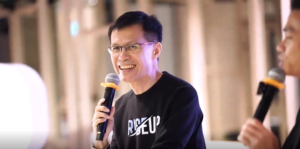
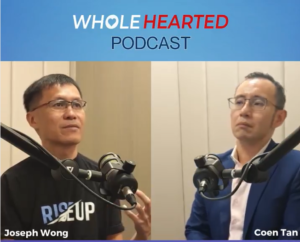
This was the core of a deeply personal and vulnerable conversation I had with my friend and fellow speaker, Coen Tan, on his Wholehearted Podcast. It wasn’t just another episode—it became a mirror, reflecting why RISEUP exists in the first place.
Because wholehearted leadership isn’t built at our peaks.
It is forged in our pits.
After nearly two decades in business, a life-threatening autoimmune illness wiped out everything I had built—my work, my momentum, my confidence, even my identity. Yet that collapse became the soil where a new kind of leadership took root:
one grounded in truth, not performance; humanity, not titles.
This is the heart of wholehearted leadership.
What Does It Mean to Lead with Your Whole Heart After Rock Bottom?
Leading with your whole heart means choosing purpose even when certainty disappears, and rebuilding leadership from the inside out.
On the podcast, Coen and I explored authentic leadership—not polished vulnerability, but the kind that is lived quietly in the dark long before it becomes something you can speak about publicly. Most people wake up each day, but they don’t always rise up.
Rising up means:
Returning to purpose even when identity feels lost
Leading with emotional courage even when confidence is thin
Showing up human first, leader second
This is the leadership that creates connection—not through performance, but through presence.
How Can Rock Bottom Become Leadership Training?
Rock bottom becomes leadership training when pain reshapes your compass, not your worth.
Between 2018 and 2021, illness forced me into complete disappearance. My body broke down. My energy vanished. My sense of self dissolved. But as I rebuilt my health, I found something deeper emerging:
clarity, compassion, and courage.
By 2022, I had nothing on paper—no clients, no money, no direction. But in reality, I had something far more powerful:
a clean slate for reinvention.
RISEUP was born from that reset.
Not from strength—but from truth.
This is the foundation of vulnerable leadership, where leaders learn to:
Lead with compassion rather than perfection
Speak from scars, not only success
Prioritise PPIs (People Performance Indicators) over KPIs
Wholehearted leadership is not soft.
It is strong because it is honest.
Why Is Vulnerability a Leadership Strength, Not a Weakness?
Vulnerability strengthens leadership by building trust, belonging, and emotional courage.
In a world obsessed with hustle, sharpness, and success optics, slowing down to lead with heart feels countercultural—but it is exactly what modern leadership requires.
Vulnerability invites:
Psychological safety
Emotional courage
Genuine connection
Cultural transformation
When leaders share their real stories, teams stop performing and start belonging.
When leaders let their humanity show, organisations shift from transactional to transformational.
Wholehearted leadership begins where ego ends.
How Does Authentic Voice Shape Leadership Impact?
Authentic voice amplifies leadership impact by creating resonance, trust, and meaningful influence.
Speaking honestly about illness, identity loss, and reinvention wasn’t comfortable. But it became my leadership truth. Not a curated message, not a brand—
a lived experience.
Podcast platforms like Coen’s create a rare space where nuance, humanity, and depth can breathe. And that’s exactly what leadership today needs more of:
Leaders who speak from lived truth rather than rehearsed scripts
Leaders who show the person behind the title
Leaders who remind teams they’re not alone in their struggles
This is the heart of authentic leadership—being real enough that others feel safe being real too.
How Does Wholehearted Leadership Redefine Strength?
Wholehearted leadership redefines strength as the courage to rebuild, reinvent, and rise again—on your own terms.
If you’re in your own season of reset, rebuilding quietly without applause, know this:
Strength is forged in silence.
Leadership is formed in loss.
And reinvention is a gift only rock bottom can give.
When you rise again, it won’t be as the person who fell.
You’ll be clearer. Bolder. More grounded.
More you.
This is why RISEUP challenges traditional leadership norms—because leadership is no longer about default paths.
It is about designing the next one.
So ask yourself:
Are you merely waking up each morning—or are you rising up?
Conclusion: Wholehearted Leadership Is the Future of Human Leadership
Wholehearted leadership is not a leadership style.
It is a leadership awakening.
It teaches us that:
Vulnerability is strength
Authenticity is influence
Resilience is identity
Humanity is strategy
Rising up is a choice
Leadership is no longer about the loudest voice, strongest image, or most polished success story. It is about leading from your scars with emotional courage, compassion, and truth.
Because when leaders rise wholeheartedly, the people they lead finally feel permission to rise too.
Better Human.
Better Leader.
Better Life.
Frequently Asked Question
What is wholehearted leadership?
How is wholehearted leadership different from traditional leadership?
Why is vulnerability important in leadership?
How can leaders rise after hitting rock bottom?
What makes authentic leadership effective?
How can I lead with emotional courage?
Can adversity improve leadership?
What does “rising up” mean in leadership?

A trailblazer in humanising leadership and building high-resilience teams. As a former United Nations Peacekeeper, he leverages his high-stakes experience to redefine leadership dynamics. With a career distinguished by numerous accolades, Joseph now helps organizations thrive through a human-centric approach, enhancing performance, productivity, and workplace culture.
Related Posts
 Leadership Is A Conscious Effort.
I finally had the opportunity to catch up with Priya Khosla, who is currently heading…
 What Is Evolving Leadership and Why Does It Matter for the Next Generation?
Evolving leadership is the practice of continuously adapting how you lead—your mindset, methods, and relationships—so…
 Do You Have The Courage To Empathise As a Leader?
It was great to catch up with Lincoln Kee, the Senior Director of Talent and…
 What Is Human-Centered Leadership Really About?
Leadership today is not about the leader — it’s about the people they lift, empower,…